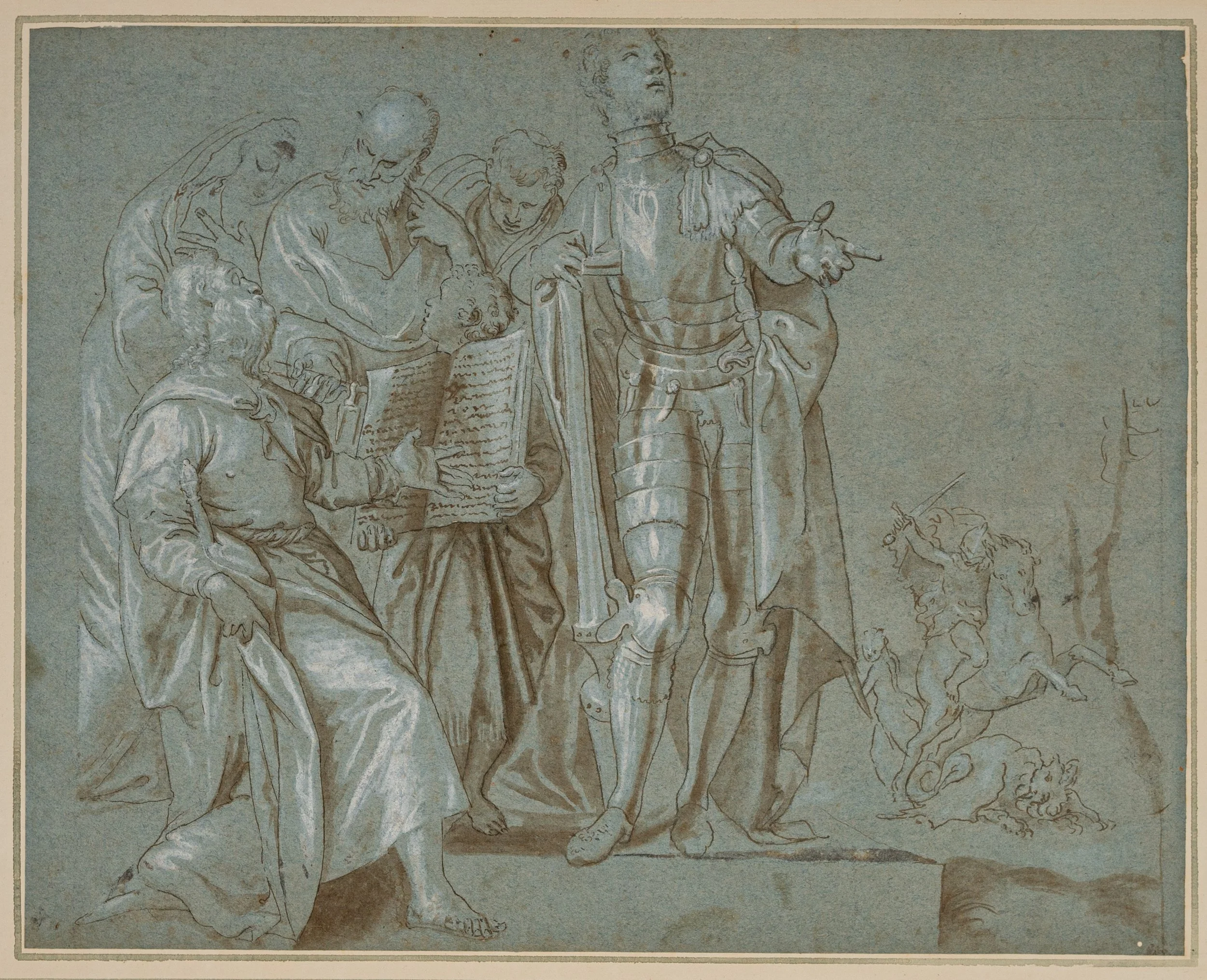
VERONESE'S CLOSE CIRCLE
Design for Lower Half of the Altar of St. George in Braida or Marega di Bevilacqua
Executed between 1550-1560.
Pen and brown ink and brown wash, heightened with white on blue paper laid down on Skippe mount; 11 x 14 in (281 x 355 mm).
Provenance: Christie, Manson and Woods sale, November 20-21, 1958, lot 91, attributed to Paolo Farinati; Private Collection NY; acquired by Decouvert in 2016.
Opinions from Julien Stock, Richard Cocke, Xavier Salomon and Diana Gisolfi.
BACKGROUND
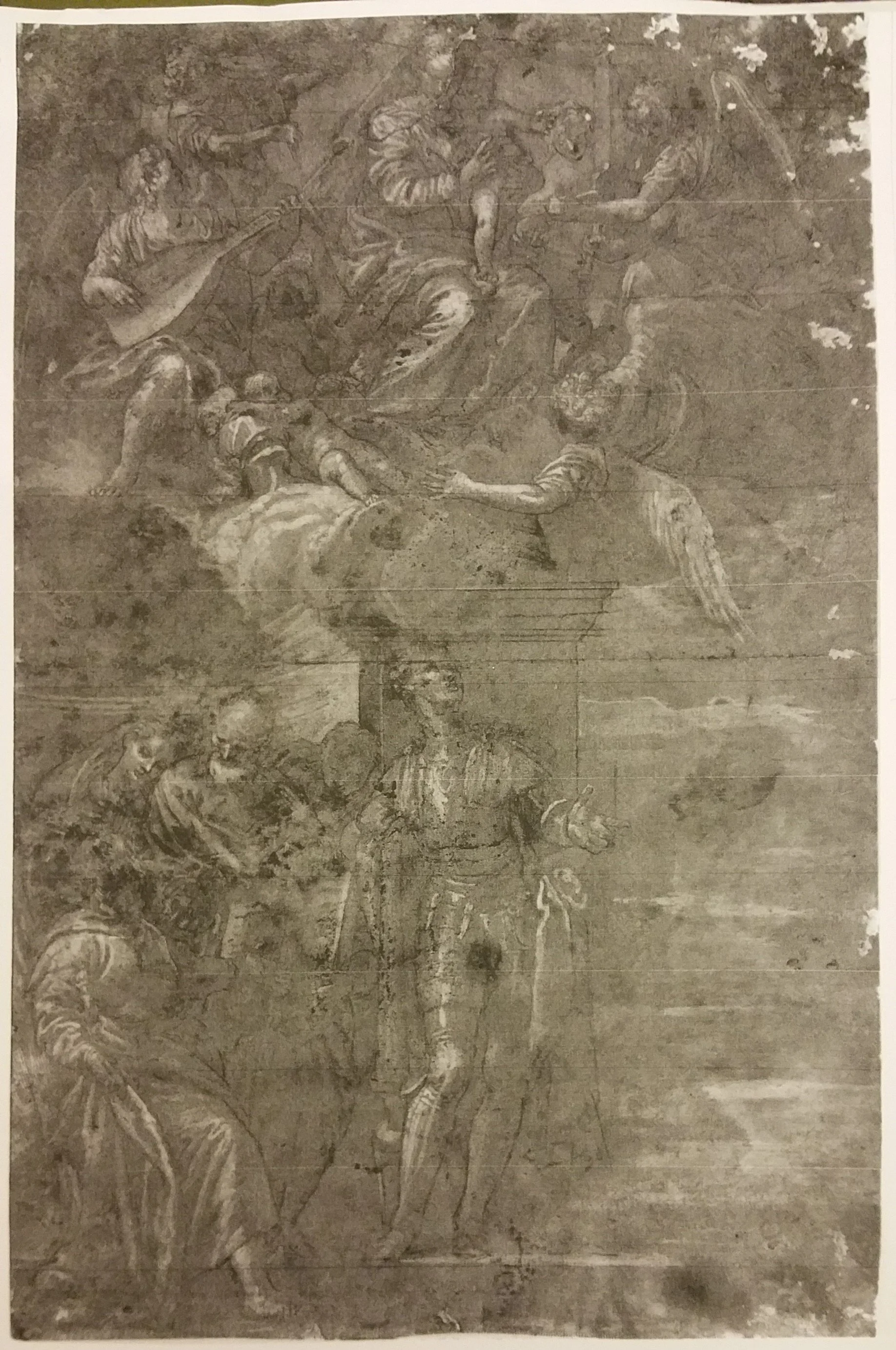
In the drawing at right from the Pouncey/Stock archive, one can see St. George with a broken lance standing against the base of a column, looking up to a heavenly apparition—the virgin and child surrounded by angels making music while St. George’s helmet is borne aloft.
One finds a similar arrangement of saints in our drawing: St. Peter holding keys, St. Paul referencing or reading a book held by a young man, St. George, and male and female figures looking on – “simply extra figures, not recognizable characters,” suggested Xavier Salomon. In our drawing, the column is missing and a small drawing of St. George and the Princess is added to the bottom right.
Many agree that this drawing is a design related to the bottom half of the Altar of Martyrdom of St. George in Braida, in Verona. Xavier Salomon wrote, “I am absolutely convinced that the drawing reflects an intermediary stage in a long series of drawings — between the 1550s and 1560s — for the Saint George altarpiece,” which proceeds from Caroto’s original altar depicting St. George’s bravery in slaying the dragon to his Veronese’s altar depicting St. George’s martyrdom. Images of these altars can be seen here.
The St. George altar was commissioned by the Canons Regular of San Giorgio in Alga, who presided at San Giorgio in Braida. The canons were described by Diana Gisolfi as, “an erudite group more than capable of determining subject matter and selecting good artists at a time when the Council of Trent had just written guidelines for church art, stressing that it should inspire piety.” There’s no question that the iconographical considerations were in flux: from a commemoration to St. George rescuing a princess to St. George being martyred for his faith.
In his book Veronese, Xavier Salomon begins his chapter “Stonecutter to Noble Painter” detailing a transcript of questions posed to Veronese by the tribunal of the Inquisition on July 18, 1571. One can appreciate immediately the attention being paid to artistic expression, even for artists of good character, as Salomon suggests through a quote from Ridolfi, “he ruled his family with great prudence, keeping his children away from harmful acquaintances and practices, teaching them with every piety about religious observance and moral disciplines (a worthy painter should always be correct and cautious).”
Questions remain as to the exact hand and function of our drawing. Clues are likely to be found in an understanding of workshop members active at the time, their complex practice and roles, and the evolution of ideas, and the collaborative nature of other master artists sharing ideas for various projects as Sergio Marinelli has suggested in Disegni Veronesi al Louvre 1500-1630. An attribution to Paolo Farinati was offered by Christie’s in the Skippe/Martin Sale of 1958.
EXPERT OPINIONS
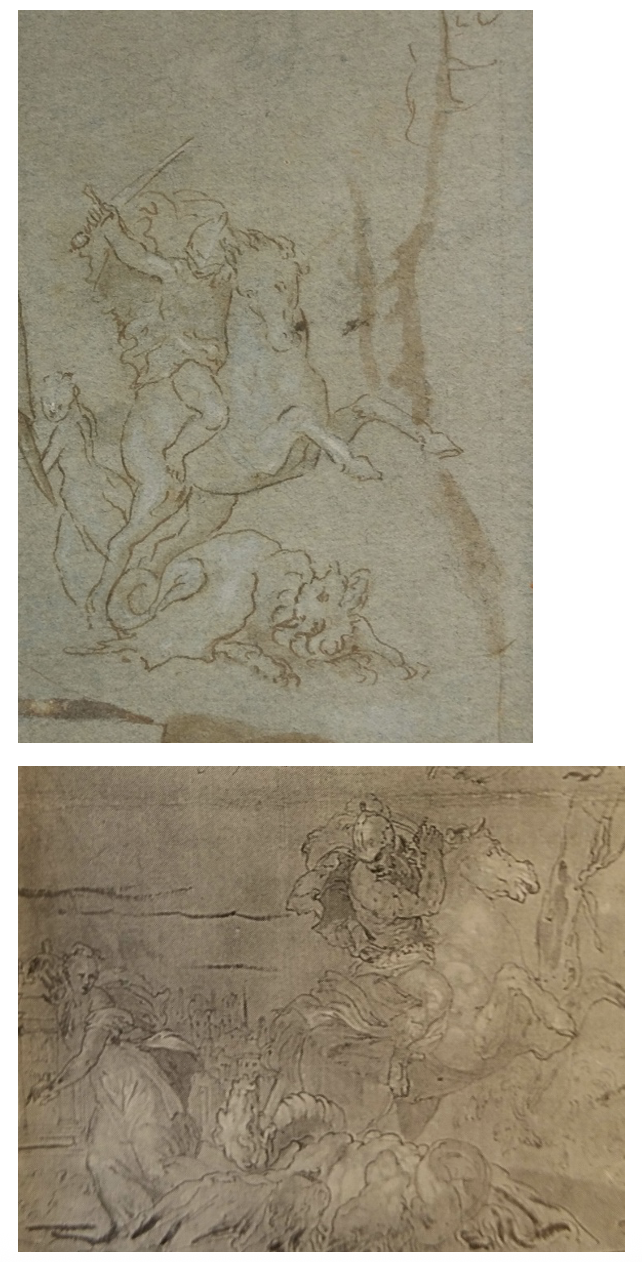
One can clearly see the experimentation by comparing a detail from drawing and a drawing attributed to Veronese by Rearick (sent by Julien Stock).
In Collaboration and Replicas in the Shop of Veronese, Artibus et Historiae, Vo. 28, No 55, pp 77-86, Diana Gisolfi wrote: “In the Venetian family workshop, staffed by numerous family members and others, a Veronese is a product of the workshop. The signature of Paolo Veronese assures quality control and supervision, as does the head of an architectural firm today.” She described a Veronese family inventory of drawings from 1682 as revealing “a complex practice of drawings varied in media, indicating different functions.” In an email about our drawing, Gisolfi wrote, “One possibility is that your drawing is a workshop copy perhaps of a portion of a modello drawing related to an idea for the San Giorgio altarpiece. And there is the possibility that it is related to a different commission involving St. George.”
Richard Cocke pointed out that the “composition is a version of both the lost Coccina altar from San Zaccaria of 1562 and the high altar in San Sebastiano c 1565.” As mentioned before, the small sketch of St. George and the Princessseems to be an addition. Architectural details from other designs – columns, for instance – are not present. Such details point to an element of experimentation. Cocke added, in agreement with Salomon: “There is, however a commission with which it might (just) be associated.