CHARLES-JOSEPH NATOIRE
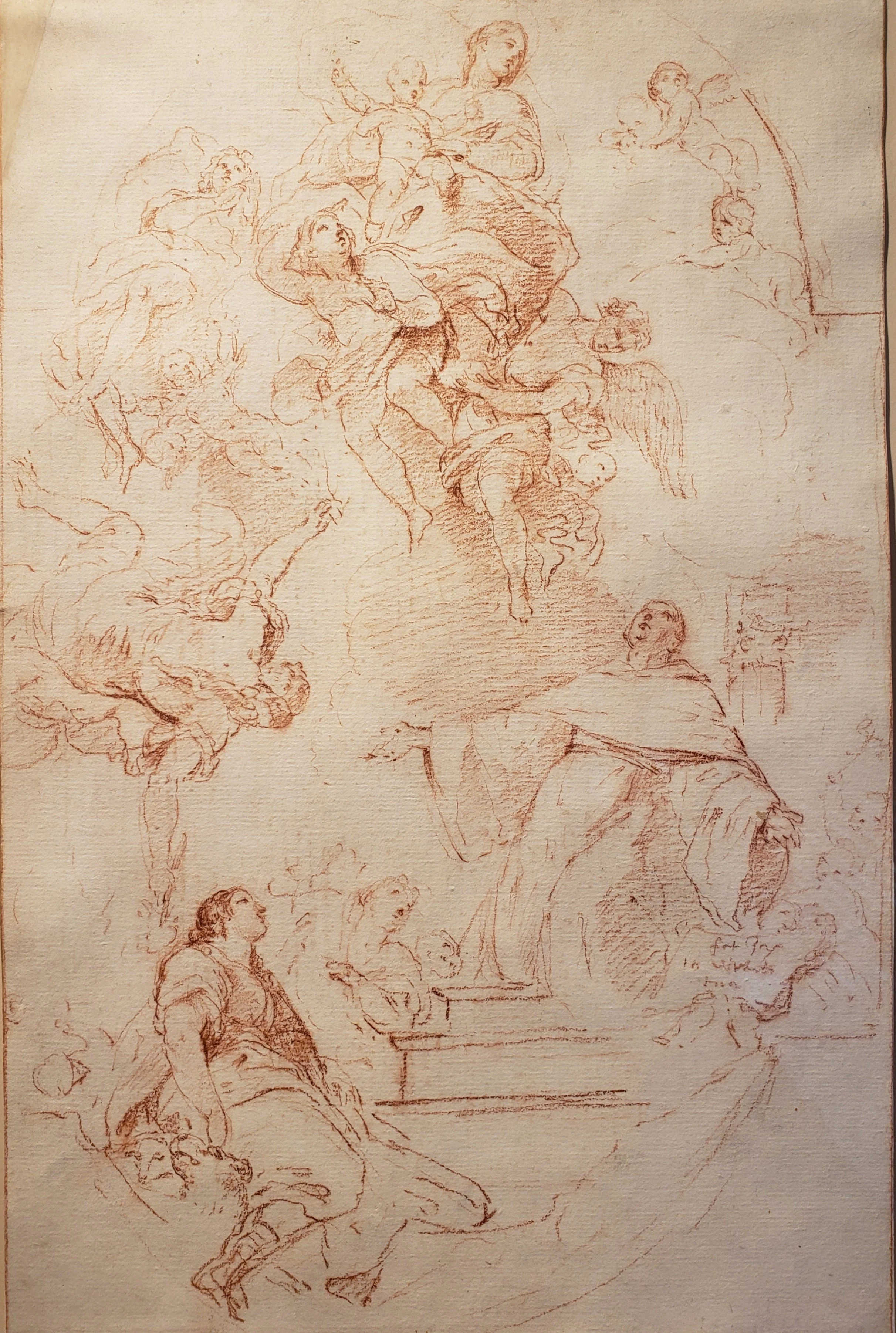
Study of Luca Giordano’s St. Bernard’s Apparition of the Virgin and Child in St. Luke’s Chapel at the Basilica della Santissima Annunziata, Florence
Nimes 1700 – 1777
c 1750-1755; Red chalk on paper; 16 ½ x 10 ¾ in. (417 x 276 mm).
This drawing is included in the catalog raisonne of Natoire’s drawings by Susanna Caviglia-Brunel. Purchased from private collection in Philadelphia in 2018. Paris art market in 2012.

BACKGROUND
An altar depicting St. Bernard’s apparition of the Virgin and Child was painted for the Santa Maria della Pace in Florence in 1685. When that church was destroyed, the painting was installed as a ceiling painting in the St. Luke’s Chapel.
Here, Mary is depicted as Regina Coeli, Queen of Heaven, no doubt inspired by mosaics in Ravenna. She and the open-armed baby Jesus are surrounded by angels. The golden light suggests her reign. In this way she personifies the church. St. Bernard below, with outstretched arms, receives the vision. His face reflects peace beyond understand. A floating female figure extends her left arm in the direction of Mary and Jesus. Her left hand holds an olive branch, signifying peace. Her right arm extends downward toward a female figure in red. In her right hand is a fire weapon of some sort, perhaps suppressing armored man flanked by a canon.
In front and below the woman in red sits a lion and lamb, perhaps a reference to Isaiah 11. 6: "The wolf will live with the lamb, the leopard will lie down with the goat, the calf and the lion and the yearling together;and a little child will lead them."
Beyond her, a figure holds a cornucopia, perhaps a reference to the heavenly banquet described in Revelation 19.9: Blessed are those who are invited to the wedding supper of the Lamb!" Other references to the heavenly banquet in scripture include Matthew 8:12, and Luke 22.
A cherub to the right of St. Bernard holds a sign that reads fiat pax in virtute tua, May there be peace in your strength.
The overall impact of these figures is to emphasize the heavenly peace brought to Earth (present and then also as a foretaste of heaven) from Jesus through Mary.
RELATED
Why Natoire’s interest? Natoire lived and worked in Rome as the director of the Académie de France in Rome from 1751 to 1775. Toward the end of his career there, he underwent a renewal of faith. His spiritual life came into conflict with his life as an artist and an administrator. Some of the students called him a “religious bigot.” One might imagine that the iconography of Giordano’s work spoke to his personal understanding of faith and inspired his own artistic life. His art began to reflect this shift away from neoclassical style.
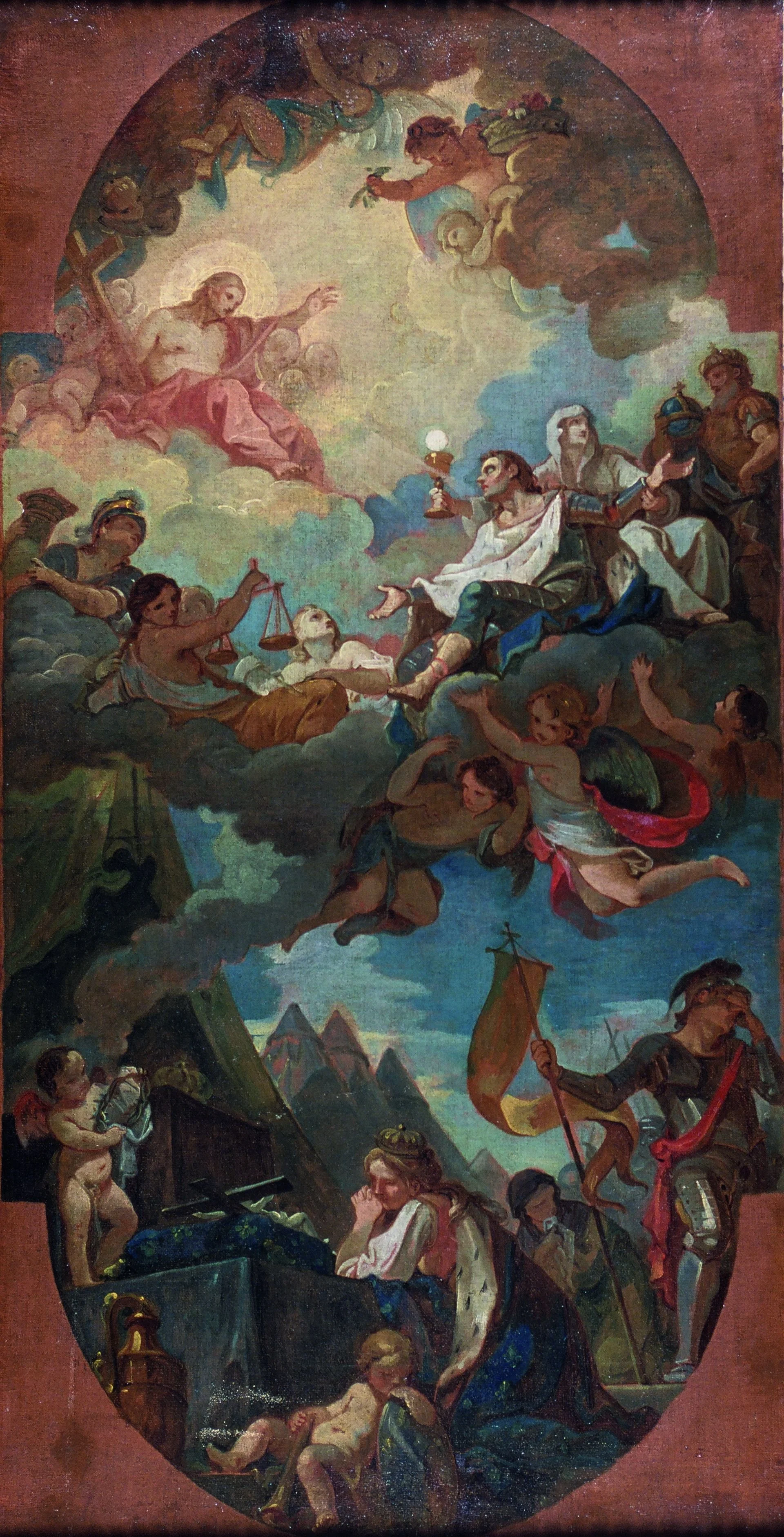
Between 1754 and 1756, he began the ceiling fresco The Apotheosis of St. Louis (also known as the Glory of Saint Louis) depicting the heavenly ascension of King Louis IX of France, located in the Church of San Luigi dei Francesi in Rome.
Charles-Joseph Natoire, Public domain, via Wikimedia Commons