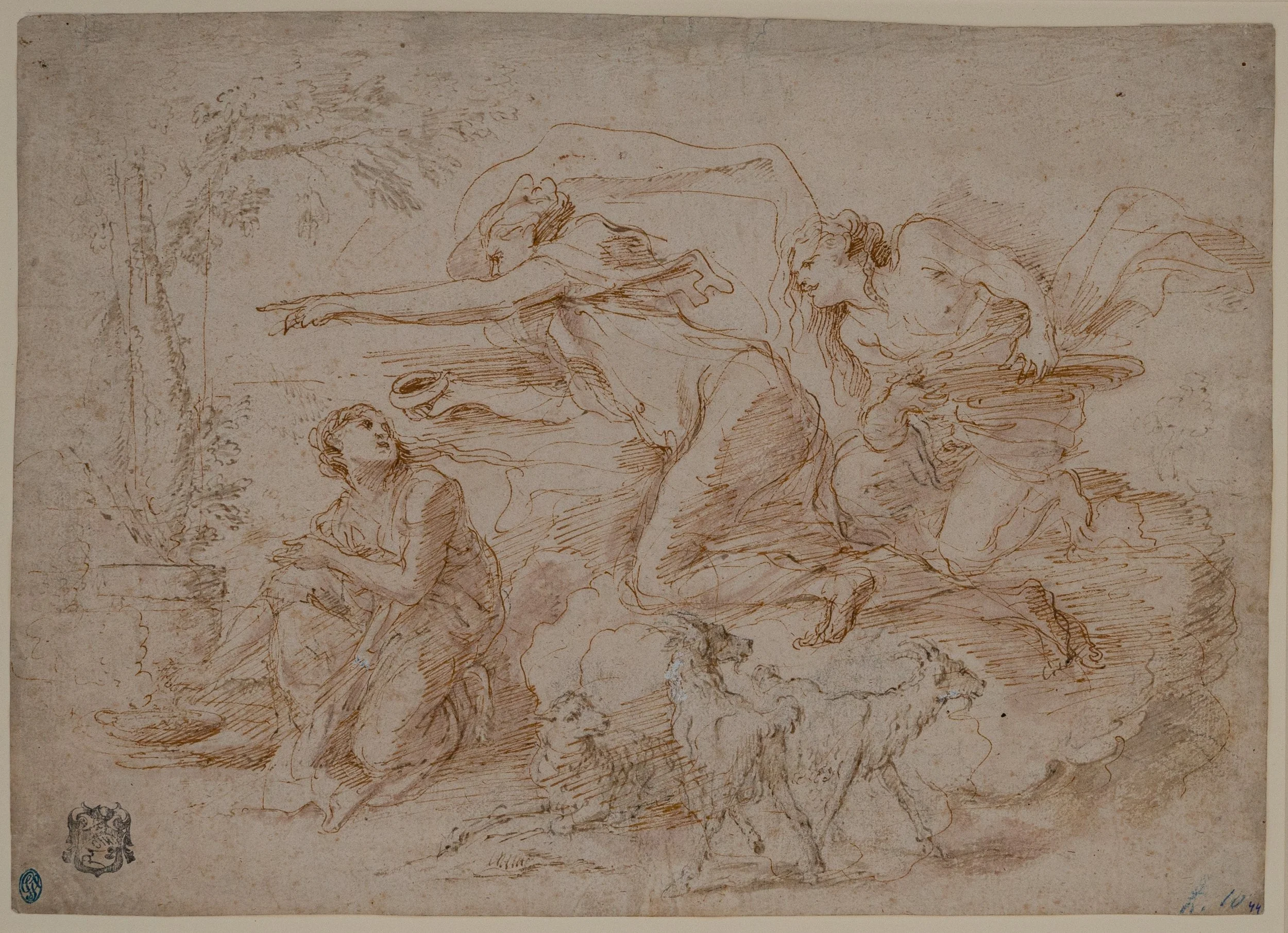
GIOVANNI BENEDETTO CASTIGLIONE CALLED IL GRECHETTO
Two Women Appearing to a Woman Near a Burning Altar
late 1640s to early 1650s
Pen and sepia ink, with wash, and brushed gray wash on cream laid paper; 257 x 362 mm
Inscribed verso, lower right, in blue ink: £ 10, and in graphite: 44 and Westphalen 1955.
Provenance: Giuseppe Vallardi (1784 - 1861), Milan, stamp (L. 1223); Giuseppe Pacini, Florence, stamp (L 2011); Christies’ London, 7 July 1998, lot 131; William M.B. and Bernadette Berger gifted to Timothy James Standring, 1999.
Iconography
Here Giovanni Benedetto improvised brilliantly over a prior composition of three goats in the foreground, as well as a twisting trunks and foliage of the tree in the background, remnants of a former drawing in his workshop, conceivably drawn earlier in his career. Very much in the spirit of Rubens’s practice of reworking and touching drawings of his own works and those of his pupils, we can see with the naked eye, the rapid broad zigzag lines providing sepia shading to reinforce the space between the two sheep to left. In other instances, the sepia lines reinforce some of the animal contours. To the left of the composition in the background, they provide an architecture armature for the twisted tree trunks that add compositional balance to the left of the composition.
Adjustments of Castiglione’s drawing style: earlier and later. While it is premature to pronounce on who might have drawn the three sheep in the foreground prior to the creative intervention, there is little doubt that the pen and sepia addition was drawn entirely by Giovanni Benedetto Castiglione’s hand.
The verve and brio of the line carries the same personal maniera of Casiglione’s inimitable line work in many of his sketches that Ann Percy has grouped together, and which now constitutes the so-called “Castiglione Album.” Whoever assembled this “album”—consisting of over 14 numbered sheets—did so by placing the works thematically into four categories: landscapes, capricci, plague scenes, and satyr family scenes. The present sheet would fall into capricci, and hence recalls similar compositional strategies to works in the Louvre (147), the Accademia, Venice; The Courtauld Institute; among others. All show a preference for placing motifs close to the front plane of the composition moving either from the right or left to the opposite side of the composition. It would be interesting to discover if this album were in fact arranged by Vallardi or Pacini, since a number of other “album” drawings possess the same provenance history.
Castiglione’s highly personal maniera stems from balancing his responses to three temperamentally different artists: Giovanni Battista Paggi, Sinibaldo Scorza, and Anton Van Dyck, whose respective examples of late maniera, naturalism, and decorative elegance prepared the Genoese to face considerable challenges when he arrived in Rome shortly after 1630. In the Eternal City, he responded to the works of such diverse contemporaries as Poussin, Rembrandt, and Bernini, and throughout his career to earlier artists such as Titian and Parmigianino, among others.
While absorbing the lessons of each in his attempts to transform himself into a commercial success, he began to give his drawings a life of their own to the extent that they should be considered as independent works of art. His graphic works essentially became the mainstay of his art. His mature drawings such as this emerged largely from his own intuitive forces, nurtured both by aesthetic notions fostered during his formative years as well as from direct observation of nature.
Castiglione was also an artist’s artist and known by artists such as Boucher, Fragonard, Reynolds, and Benjamin West, as well as by collectors such as Bailly de Breteuil, Jean-Pierre Mariette, and Pierre Crozat, among others—all of whom helped increase his critical fortune..
—Timothy J. Standring
Related Bibliography
A. Blunt, The Drawings of G.B. Castiglione & Stefano della Bella in the Collection of Her Majesty the Queen, 1954, no. 31, 34, and 44.
Ann Percy, “A Castiglione ‘Album’, Master Drawings 6, no. 2 (1968), pp. 144- 148.
Ann Percy, Giovanni Benedetto Castiglione, Philadelphia, 1971.
Kristin Lohse Belkin, Rubens. Copies and Adaptions from Renaissance and Later Artists: German and Netherlandish Artists (Corpus Rubenianum Ludwig Berchard, Part XXVI [I]. London: Harvey Miller Publisher (an imprint of Brepols Publishers, Turnhout), 2009, 2 vols.
Timothy J. Standring and Martin Clayton, Castiglione: Lost Genius, London 2013.